








“Give your gadgets a second life; the Nature Doesn’t Need Your Old Devices.”
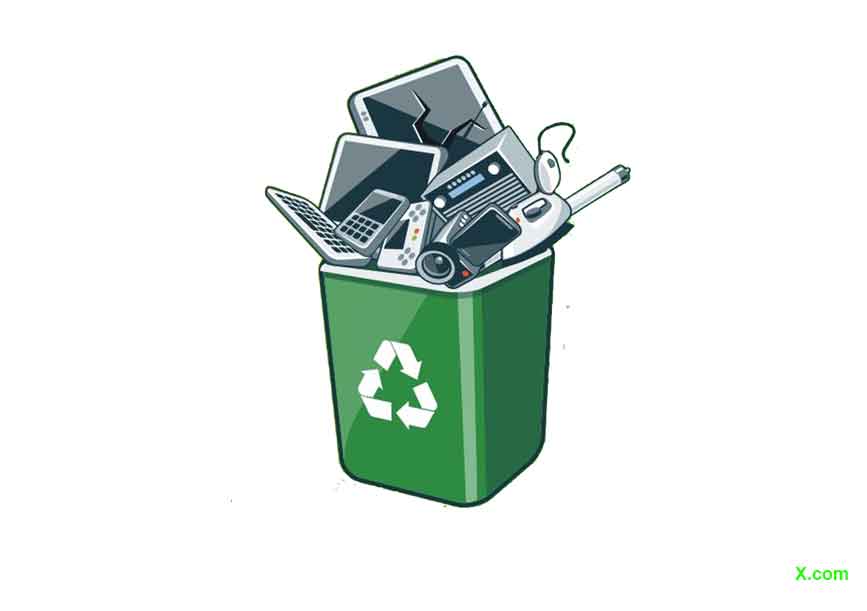
International E-Waste Day is observed on 14 October. Electronic waste or e-waste refers to all items of electrical and electronic equipment and its parts that have been discarded when on no use. E-waste includes discarded computer monitors, motherboards, mobile phones, chargers, CDs, headphones, television sets, air conditioners and refrigerators and anything like a plug, cables, or battery, USB keys, card readers, game consoles and other electronic devices.
The theme for 2025 is “Recycle your e-waste – It’s critical!” This theme highlights the importance of recycling e-waste to recover critical raw materials (CRMs) that are essential for the green and digital transitions. The day focuses on our responsible disposal and recycling practices and by e-waste management; everyone can contribute to pollution reduction, resource conservation, and energy and CO₂ savings.
When electronic devices and components are disposed of improperly, they often end up in landfills or incinerators. Electronics contain various hazardous substances such as lead, mercury, cadmium and flame retardants, which can leach into soil and water sources, polluting ecosystems and posing risks to human health. Mercury damages the human brain and coordination system.
E-waste also contains valuable resources like gold, silver and copper, as well as rare and strategic elements, which are crucial for the green transition and production of new electronic devices. When e-waste is not recycled properly, these valuable materials go to waste.
According to UN Institute for Training and Research (UNITAR), a record 62 million tons of e-waste was produced in 2024 which could fill 1.55 million 40-ton trucks, roughly enough to form a bumper-to-bumper lined up trucks encircling the equator. These e-wastes are up 82% from 2010 and on track to rise another 33% to 82 million tons in 2030. Billions of rupees worth of strategically-valuable resources squandered, dumped and just 1% of rare earth element in e-waste is recycled which is less than 22.3% of the annual e-waste, leaving Rs.5208 billion worth of recoverable natural resources unaccounted for and increasing pollution risks to communities worldwide. The report underlines that if countries could bring the e-waste collection and recycling up to 60% by 2030, the benefits – including through minimizing human health risks – would exceed costs by more than Rs.3192 billion.
Challenges contributing to the widening gap include technological progress, higher consumption, limited repair options, shorter product life cycles, society’s growing electronification, design shortcomings, and inadequate e-waste management infrastructure.
According to United Nations, the worldwide, annual generation of e-waste is 65.6 million tons which is around 8 kg of e-waste per person. This means the e-waste discarded within a year – more than the weight of the Great Wall of China. Only 17.4% of this waste, containing a mixture of harmful substances and Critical Raw Materials are being collected, treated and recycled globally. The remaining 52.6 million tons are either in landfill, burned, or illegally traded and treated in a sub-standard way or simply hoarded in the household mobility.
UNITAR is assessing, almost 1/6th of all invisible e-waste by mass – 9 billion kg per year could go unnoticed. E-toys alone account for 1/3 of this category with 7.3 billion pieces generated each year – that’s almost one discarded e-toy for every person on the planet. Vapes – quickly gaining in popularity in many countries; 844 million of these devices were thrown away in 2024 which equals the weight of 6 Eiffel Towers.
Small items such as cell phones, cameras, electric toothbrushes, toasters produced worldwide will weight an estimated 24.5 million tons – four times the weight of the Great Pyramid of Giza which makes up 8% of all e-waste thrown into trash bins and incinerated. Researchers’ shows roughly 5.3 billion mobile phones will drop out of use this year. Stacked flat atop one another at an average thickness of 9 mm disused phones would rise roughly 50,000 km – 120 times higher than the International Space Station; one-eighth of the way to the Moon.
But for every million cell phones that are recycled, 16000 kg of copper, 350 kg of silver, 24 kg of gold and 14 kg of palladium could be recovered. E-waste is a true ‘urban mine,’ and in some respects even richer than traditional mining: for example, there is 100 times more gold in a ton of smartphones than in a ton of gold ore.
India’s first e-waste clinic for segregating, processing and disposal of waste from household and commercial units has been set-up in Bhopal. A key factor in used electronic devices not being given for recycling is because consumers themselves did not do so. In the country, about 4.5 lakh child laborers in the age group of 10-14 are engaged in various e-waste activities and that too without adequate protection and safeguards in various yards and recycling workshops.
There is the absence of any public information on most State Pollution Control Boards. E-waste contains over 1,000 toxic materials, which contaminate soil and groundwater. No clear guidelines are there for the unorganized sector to handle e-waste. Also, no incentives are mentioned to lure people engaged to adopt a formal path for handling e-waste. In India- 80% of e-waste from developed countries is import for recycling.
India under the E-Waste Management Rules, 2016 and amended it in 2018 has the rules under Extended Producer Responsibility (EPR), along with targets where producers have been made responsible for the collection of E-waste and for its exchange, as well as its disposal in an environmentally sound manner.
Manipur produce substantial amount of e-waste as the state is also running fast with the changing world. For e-waste management, the state needs a collective effort from all stakeholders on handling, recycling and disposal.
The continuing growths in the production, consumption and disposal of electronic devices have huge environmental and climate impacts. The avalanche of problems with e-waste will face unless we take appropriate measures, without which global e-waste could be 100 million tons or more in the next 30 years. Consumption of electronics items is directly proportional to the human development but our need is, E-Waste Hunt – Retrieve, Recycle and Revive. Ignore e-waste today struggle to breathe tomorrow.
Dr. N. Munal Meitei
Environmentalist, presently working as DFO/Chandel
Email- nmunall@yahoo.in